
The Science of TOPS
Were You Recommended Spinal Fusion Surgery? Read This Before You Decide.
Fusion may not be your only option. Learn how motion-preserving TOPS™ surgery works, and who it may be right for.
In the FDA-reviewed pivotal trial, TOPS™ demonstrated statistical superiority over fusion on the primary composite endpoint at 24 months (75.9% vs. 23.9%).
Individual results vary. This page is educational and is not medical advice. Only a spine surgeon, after an evaluation that includes your history and imaging, can determine whether TOPS™ is right for you.
Learn more about the TOPS Motion Device. Contact us.

A big decision deserves a clear picture of your options
Many people hear “spine surgery” and assume fusion is the only path. For certain adults with lumbar spinal stenosis and a degenerative slip, a motion-preserving option may also be worth discussing with a spine surgeon.
Non-surgical care and decompression alone are also options. Discuss all of your options with your physician.
When the spinal canal narrows and a vertebra slips
Two common age-related changes in the lower back often appear together. Understanding each one helps explain why surgeons approach treatment the way they do.
Lumbar spinal stenosis
A narrowing of the spaces in the lower spine. Thickened ligaments, enlarged facet joints, and disc changes can crowd the nerves that travel to the legs.
Degenerative spondylolisthesis
One vertebra slips forward over the one below it because of wear in the joints and ligaments that normally hold it in place. “Grade I” describes the mildest degree of slip.
How it can feel
People with these conditions may describe leg pain, numbness, tingling, or heaviness when standing or walking that eases when sitting or bending forward. These symptoms have many possible causes, so only a doctor can make a diagnosis.
Symptoms come from pressure on the nerves. Surgery, when it is recommended, starts by relieving that pressure. The next question is what to do about stability.

Surgery decisions are personal. Tell your surgeon what matters most to you, and ask how each option fits your goals.
Illustrative image; models, not actual patients. Individual results vary.Already been told you may need back surgery?
Find out whether TOPS™ may be right for you. A surgeon will decide what’s right for you.
Fusion vs. motion preservation, explained
For stenosis with a degenerative slip, surgery usually begins with a decompression: the surgeon removes bone and tissue that press on the nerves. Because that can leave the segment less stable, the surgeon may also stabilize it. Fusion and TOPS™ take different approaches to that step.
| Lumbar fusion | TOPS™ System | |
|---|---|---|
| Goal after decompression | Stabilize the segment by joining two vertebrae so they heal into one solid piece of bone. | Stabilize the segment with an implant that replaces the removed bony structures, without rigid fixation. |
| Motion at the treated level | Designed to eliminate motion at that level. | Designed to maintain motion in flexion, extension, lateral bending, and axial rotation, and to block forward/backward sliding. |
| Hardware | Typically pedicle screws and rods, often with bone graft and/or an interbody cage. | Four pedicle screws and the TOPS™ Motion Implant. |
| Who it’s for | Used for many spinal conditions and levels. | FDA-approved for a specific group: ages 35–80, Grade I degenerative spondylolisthesis with moderate to severe stenosis, one level from L3 to L5. |
| Risks | Both are major spine surgeries with real risks. Your surgeon can explain the risks and benefits of each option for you. | |
Non-surgical care (such as physical therapy, medications, and injections) and decompression alone are also options. Discuss all options with your physician.
How the TOPS™ System is designed to work
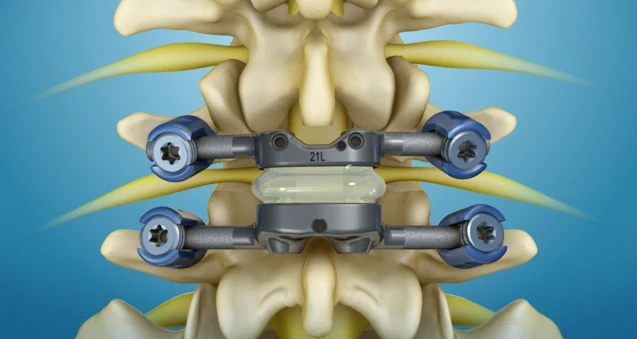
TOPS™ is a motion-preserving implant placed from the back of the spine. It is intended to stabilize the spine after a lumbar decompression, without fusing the vertebrae together.
The TOPS™ Motion Implant has two titanium endplates connected by a flexible polycarbonate urethane (PcU) boot. Inside, titanium and PcU articulating parts and a woven PEEK ribbon allow controlled movement between the endplates.1
Decompress
The surgeon removes the bone and tissue (such as parts of the lamina and facet joints) that press on the nerves.
Stabilize
The TOPS™ Motion Implant is attached with four pedicle screws, replacing the structures removed during decompression.
Allow controlled motion
The implant is designed to allow bending forward and back, side to side, and twisting, while blocking the vertebra from sliding.
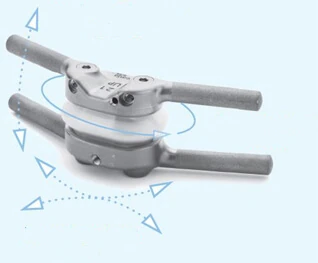
What “motion-preserving” means, and doesn’t. TOPS™ is designed to maintain motion at the treated level. In the FDA trial, range of motion in flexion/extension at that level was maintained from before surgery through 24 months in the TOPS™ group.1 It does not mean the spine is restored to “normal,” and long-term effects are still being studied.
Want to ask a surgeon about motion preservation?
Find out whether TOPS™ may be right for you, and our patient team will follow up.
What the FDA pivotal trial measured
TOPS™ was studied in a prospective, multicenter, randomized trial in the U.S. that compared it with lumbar fusion. 321 patients were enrolled at 37 U.S. sites and randomized 2:1 (TOPS™ : fusion).1
Composite clinical success at 24 months1
Primary endpoint · patients with 24-month data (TDmITT analysis set, observed data)
The FDA concluded TOPS™ was superior to fusion “for the subject population and indications studied in this investigation, in terms of overall success according to the protocol-specified primary endpoint.”1 Individual results vary.
- ≥15-point improvement in disability score (ODI)
- No new or worsening neurologic deficit
- No spinal injections or spinal cord stimulator for back or leg pain
- No revision, removal, or supplemental fixation
- No major device-related adverse event
- Radiographic criterion (see below)
Important context
- The radiographic criterion differed by group. A TOPS™ patient counted as a failure if the level fused; a fusion patient counted as a failure if it did not fuse. The FDA noted that TOPS™ results on motion and fusion status were “not an unexpected result” given that fusion eliminates motion and TOPS™ is designed to preserve it.1
- Not every measure was better. At 24 months, 83.2% of TOPS™ patients and 75.6% of fusion patients had not used opioids or lumbar injections; this difference was not statistically significant.1
- Results apply to the population studied: adults with Grade I degenerative spondylolisthesis and stenosis at one level who met the trial’s criteria. Your results may differ.
Source: FDA Summary of Safety and Effectiveness Data (SSED), PMA P220002.
Questions you may want to ask at your next visit
Bringing a short list can help you get the most out of your appointment.
- What are all of my options, including non-surgical care and decompression alone?
- Am I within the FDA-approved indication for TOPS™?
- How do fusion and TOPS™ compare for someone with my history and imaging?
- What are the risks of each approach, and what might recovery involve for me?
- Do you perform TOPS™, or can you refer me to a surgeon who does?

Who TOPS™ may be for
TOPS™ is FDA-approved for a specific group of patients. Meeting these criteria does not mean TOPS™ is right for you. A physician evaluation, including imaging, is required.

TOPS™ is indicated for adults who:
- Are between 35 and 80 years of age
- Have symptomatic degenerative spondylolisthesis up to Grade I
- Have moderate to severe lumbar spinal stenosis, with thickening of the ligamentum flavum and/or scarring of the facet joint capsule
- At one level, from L3 to L5
Only a spine surgeon can determine whether you are a candidate.
TOPS™ should not be used in people with:
- A disc herniation (extruded or free fragment) at the level to be treated
- Spondylolisthesis greater than Grade I, or traumatic, dysplastic, or lytic spondylolisthesis
- Back or non-radicular leg pain of unknown cause
- Stenosis that is congenital, iatrogenic, post-traumatic, or metabolic
- Allergy or sensitivity to PEEK, titanium, and/or polyurethane
- Scoliosis greater than 10 degrees (Cobb angle)
- Body mass index (BMI) greater than 40
- Lumbar spine T-score less than −2.0 (low bone density)
- Active infection
- Cauda equina syndrome or neurogenic bowel/bladder dysfunction

Come see if you may be a fit for TOPS™
Share your details, and a member of our patient team will follow up to talk about whether TOPS™ may be right for you.
- Share your contact detailsYour name, phone, and email, plus a few optional questions.
- Our patient team contacts youWe answer your questions and explain what the next steps could look like.
- You decide on next stepsIf you choose, you schedule an evaluation. The surgeon reviews your history and imaging and discusses all of your options, including their risks.
Submitting the form does not create a doctor–patient relationship.
Learn more about the TOPS Motion Device. Contact us.
Frequently asked questions
General information only, not medical advice. Your surgeon is the best source of answers about your care.
Is TOPS™ right for me?
Only a spine surgeon can decide that, after reviewing your symptoms, exam, and imaging. TOPS™ is FDA-approved for adults 35–80 with symptomatic Grade I degenerative spondylolisthesis and moderate to severe lumbar spinal stenosis at one level from L3 to L5. Many people with back or leg pain are not candidates.
Is the TOPS™ System FDA-approved?
Yes. The FDA granted premarket approval (PMA P220002) on June 15, 2023, based on a randomized U.S. trial that compared TOPS™ with lumbar fusion.
How is TOPS™ different from a spinal fusion?
Both are performed after a decompression. Fusion joins two vertebrae so the level no longer moves. TOPS™ is an implant designed to stabilize the level while maintaining motion. Each has its own risks and benefits, which your surgeon can explain.
What are the risks?
TOPS™ surgery carries the risks of any major spine surgery, including anesthesia complications, bleeding, infection, nerve injury, and the possibility that the surgery does not relieve or worsens symptoms. Implant-related risks include device breakage, loosening, or an adverse reaction to the materials. Additional surgery may be needed.
What is recovery like?
Recovery is different for everyone and depends on your health, the procedure, and your surgeon’s plan. Ask your surgeon what to expect for activity, work, and follow-up visits. Individual results vary.
Can TOPS™ be used at more than one level?
In the U.S., TOPS™ is FDA-approved for use at one level, from L3 to L5.
Is TOPS™ covered by insurance or Medicare?
Ask your insurance plan and your surgeon’s office about your benefits.
What happens after I submit the form?
A member of the Premia Spine patient team will contact you to talk about whether TOPS™ may be right for you. Any decision about surgery is made by you and your surgeon.

Come see if you may be a fit for TOPS™
Tell us how to reach you. A surgeon will help you decide what’s right for you.
See If TOPS May Be Right for Me Illustrative image; models, not actual patients. Individual results vary.
References
- U.S. Food and Drug Administration. Summary of Safety and Effectiveness Data (SSED): TOPS™ System, PMA P220002. Approved June 15, 2023.
Individual results vary. This page is for educational purposes and does not replace a consultation with a qualified physician. Premia Spine does not provide medical advice or diagnosis. Surgeon information is provided as a service; Premia Spine does not endorse any specific surgeon.
TOPS™ is a trademark of Premia Spine. © 2026 Premia Spine. All rights reserved. · Privacy Policy